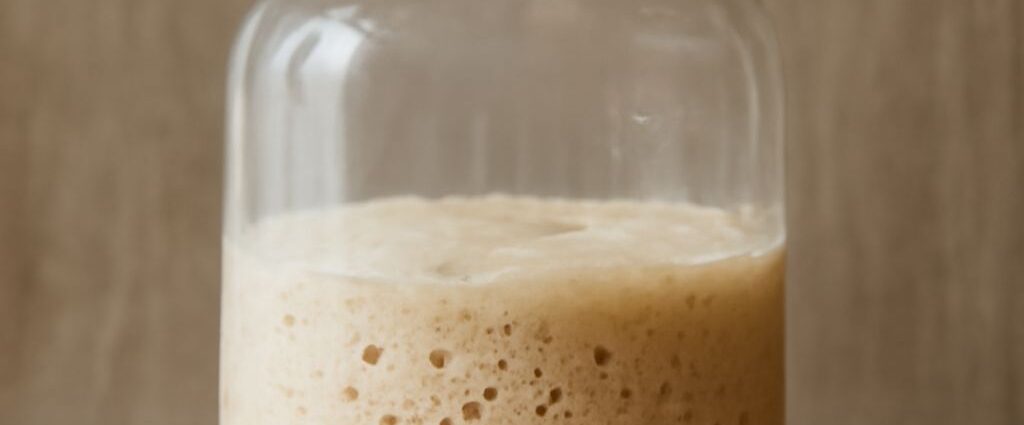
The right feeding schedule depends on where you keep your mature starter and how often you bake. At room temperature, it needs fresh flour and water more often; in the refrigerator, fermentation slows and weekly attention is usually enough. Feeding a mature sourdough culture is a small kitchen habit with a big reward: a lively mixture ready to raise your next loaf.
You can care for your established starter with a jar, a scale, flour, and water. Watch how it rises and smells as well as the clock, and you will soon know when it is hungry and when it is ready to work.
What a feeding does
A starter is a community of wild yeast and bacteria living in flour and water. The yeast produces gas, while the bacteria contribute acidity and flavor. Fresh flour supplies food; water keeps the mixture workable. As the culture ferments, bubbles form and the starter expands, then falls as its food supply dwindles.
Learning how to feed a sourdough starter starts with keeping only a small portion before adding fresh ingredients. This keeps the amount manageable and gives the microorganisms enough new food. Refresh your sourdough starter with flour and water at each feeding. A clean, clear, straight-sided jar makes the rise easier to see. Leave plenty of headroom and cover the jar loosely so gas can escape.
How to Maintain a Sourdough Starter at Home
Knowing how to maintain a sourdough starter becomes much easier when every feeding follows the same proportions. Use equal weights of retained starter, flour, and water: a 1:1:1 ratio. Here is a small, practical feeding:
- Put a clean jar on a digital scale and set it to zero. Add 25 grams of mature starter, about 0.9 ounce. Set the rest aside as discard.
- Add 25 grams of room-temperature water and stir to loosen the starter.
- Add 25 grams of flour. Mix until no dry pockets remain, scraping down the sides.
- Mark the mixture’s level with a rubber band or piece of tape. Cover loosely and let it ferment.
You now have 75 grams, or about 2.6 ounces, of starter. The ratio is by weight, not volume: a spoonful of flour and a spoonful of water do not weigh the same. An inexpensive scale makes the calculation straightforward and saves you from a guessing game.
Unbleached all-purpose flour is a dependable choice. If your starter normally eats another flour, continue with it for consistency. Whole-grain flour can encourage activity, but it also absorbs water differently; expect a thicker mixture and observe how the culture responds. Use drinkable water and a clean utensil each time.
Choose a schedule that fits your baking
For frequent baking, leave the jar at a comfortable room temperature and feed approximately every 12 hours. A warm kitchen makes fermentation quicker; a cool one slows it. If the mixture rises and falls well before the next feeding, it may need food sooner. Maintaining a sourdough starter on the counter works best when you can observe it regularly.
For less frequent baking, keep your sourdough starter healthy in the refrigerator with a feeding at least once a week. Remove the jar, retain 25 grams, and add 25 grams each of flour and water. Leave it covered at room temperature for a few hours, until activity begins, then return it to the refrigerator. The cold slows the culture, giving you a longer interval between meals.
To keep a refrigerated sourdough starter active, plan ahead before baking. Bring it out a day or two in advance and give it feedings at room temperature roughly 12 hours apart until it reliably rises after feeding. This gives the yeast time to regain strength. King Arthur Baking’s maintenance guide offers a useful reference for both schedules.
Read the rise, bubbles, and aroma
After feeding, the mixture should develop bubbles throughout and rise noticeably. A healthy, active starter often doubles in a warm kitchen, though the timing depends on temperature, flour, and its recent care. A gently domed top suggests it is still rising; at its peak it is expanded and bubbly, with the top beginning to flatten. A line of residue above the current level shows that it has already risen and fallen.
Use a fed sourdough starter at or near its peak when your bread recipe calls for active starter. A pleasantly tangy, fruity, or yeasty smell is another encouraging sign. Marking the starting level lets you see its progress without standing guard over the jar. Your starter will not mind if you have other plans.
If the recipe needs more than your small feeding produces, increase all three amounts equally. For example, 50 grams each of starter, water, and flour yields 150 grams. Set aside enough to continue the culture before measuring the amount for your dough. If 25 grams remain, feed that portion on your usual schedule.
Make good use of the extra
The portion removed before a feeding is called discard. It can add flavor to pancakes, crackers, or other recipes designed for it, although an unfed portion may not have the lifting power needed for bread. Save sound discard in a covered container in the refrigerator and use it in a recipe that cooks it thoroughly. Never taste raw starter or raw flour.
Regular care of a sourdough culture includes keeping its container clean. Care for your sourdough starter by transferring it to a fresh jar when buildup collects on the sides, and use clean utensils for both the retained portion and discard. Compost or throw away extra discard if you do not need it; a small feeding routine keeps the surplus modest.
Discard is only useful when the culture is sound. Throw away the entire starter and any discard from it if you see fuzzy mold or pink or orange discoloration, or notice a putrid, rotten smell. Do not scrape off the affected area and save the rest. King Arthur’s sourdough FAQ describes these spoilage signs.
When the starter seems sluggish
How to care for a sourdough starter that barely rises? First check the room temperature and its feeding history. A cold kitchen or a long stay in the refrigerator can slow a healthy culture. Move it to a comfortably warm spot, around 75°F. Feed the mature sourdough starter every 12 hours, using a 25-gram portion with equal weights of flour and water. Mark the level and look for improvement over several feedings.
A grayish liquid on top or an alcohol-like smell usually means the starter is hungry. Stir the liquid in or pour it off, then feed as usual. If it smells rotten or shows mold or pink or orange streaks, discard it instead. For everyday sourdough starter maintenance, patience and a regular meal are often all a slow starter needs.










Comments are closed, but trackbacks and pingbacks are open.