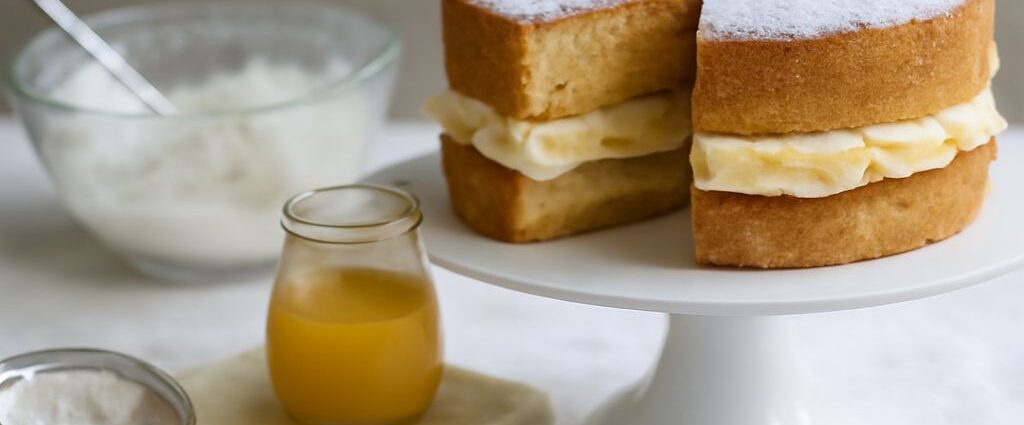
A light sponge should rise into a golden layer with a soft, springy crumb. This straightforward recipe for an airy cake starts with whole eggs and sugar beaten into a thick foam; careful folding keeps the air in place as the flour goes in.
Learning to make a sponge cake is mostly a matter of recognizing two stages: the ribbon left by the beaten eggs and the gentle spring of the baked cake. Prepare the pan first, give the mixer enough time, and the batter can go straight into a hot oven.
How to make sponge cake: ingredients and equipment
This recipe makes one 8-inch round layer, about 8 servings. Allow 20 minutes to prepare, 25 to 30 minutes to bake, and at least 1 hour to cool. Use a round metal pan at least 2 inches deep, an electric mixer, a large bowl, a fine-mesh sieve, and a flexible spatula.
- 4 large eggs, at room temperature
- 2/3 cup granulated sugar (about 132 grams)
- 1 teaspoon vanilla extract
- 3/4 cup all-purpose flour (90 grams)
- 1/4 teaspoon fine salt
- A little neutral oil or butter for the pan
This simple sponge cake recipe uses whole eggs, so there is no separate bowl of whites to whip. Their foam provides the lift; this cake does not rely on baking powder. Sugar sweetens and helps stabilize the foam, while flour gives the baked layer structure. Vanilla adds flavor without weighing down the batter.
For consistent measuring, weigh the flour if you can. Otherwise, fluff it, spoon it gently into the measuring cup, and level the top. A cup packed by scooping can hold considerably more flour, making a delicate cake heavier than intended.
Mix and bake the sponge
- Prepare the oven and pan. Heat the oven to 350°F with a rack in the center. Lightly grease the bottom of an 8-inch round pan, line it with a parchment circle, and lightly grease the parchment. Leave the sides ungreased. The pan should be at least 2 inches deep; the batter should fill it no more than about two-thirds full.
- Sift the flour. Combine the flour and salt and sift them onto a sheet of parchment or into a small bowl. This breaks up lumps before they meet the foam.
- Whip the eggs and sugar. In a large mixing bowl, beat the whole eggs and sugar with an electric mixer on high speed until very pale, thick, and greatly increased in volume, about 6 to 10 minutes. Lift the whisk: the mixture should fall in a thick ribbon that sits on the surface for several seconds before slowly disappearing. Beat in the vanilla briefly.
- Fold in the flour. Sift about one-third of the flour mixture over the foam. Using the spatula, cut down through the center, sweep across the bottom, and lift the batter over itself while turning the bowl. Repeat with the remaining flour in two additions, folding just until no dry streaks remain. Scrape the bottom gently, where flour can hide.
- Bake. Transfer the batter gently to the prepared pan and smooth the top. Bake immediately for 25 to 30 minutes, until golden, lightly springy in the center, and a toothpick inserted into the middle comes out clean. Avoid opening the oven during the first 20 minutes.
- Cool. Set the pan on a rack for 10 minutes. Run a thin knife around the edge, turn the cake out onto the rack, and peel off the parchment. Turn it right side up and cool completely before slicing or adding a filling.
The batter should be thick and airy when it reaches the pan, like a soft foam rather than a pourable pancake mixture. Do not tap the pan hard on the counter: the bubbles you just made are the cake’s lifting power.
What the ribbon tells you
What makes a sponge cake recipe easy is knowing when the egg mixture is ready. Time is only a guide because mixers differ. The foam should look pale and voluminous, and a trail from the raised whisk should remain visible briefly on top. If the trail vanishes as soon as it lands, continue beating and test again.
The ribbon stage means air has been incorporated into the eggs and sugar. In the oven, that air expands while the egg and flour structure sets around it. King Arthur Baking’s explanation of ribbon stage includes the same visual cue: a thick trail that falls from the whisk onto the surface.
Room-temperature eggs whip readily. To take the chill off refrigerator-cold eggs, place the uncracked eggs in a bowl of warm tap water for about 5 minutes, then dry and crack them into the mixing bowl. The water should feel warm, not hot. Start with a clean, roomy bowl so the mixture has space to expand.
Fold gently, but finish the job
Knowing how to make sponge cake includes folding flour in while keeping as much air as possible. Hold the spatula vertically, cut through the middle, sweep along the bottom, and lift up and over. Rotate the bowl a little between strokes. It is a slow scooping motion, not the brisk circular stirring you might use for pancake batter.
Sifting the flour over the surface in small additions helps prevent heavy clumps from sinking. Look for dry flour along the sides and especially at the bottom. A few extra deliberate folds are better than a pocket of flour in the finished slice, but stop once the mixture is even. Beating the flour in with the mixer can knock out the foam and develop a tougher crumb.
Have the oven fully preheated before you begin mixing. Once combined, the batter should go into the prepared pan and oven promptly. If the bowl waits on the counter while the oven warms, some of its air can escape. The cake has already done its warm-up; it is ready for the main event.
Sponge cake and butter cake: different methods
In this easy sponge cake recipe, the eggs and sugar are whipped first, then the flour is folded into their foam. A typical butter-based vanilla cake often starts by beating butter and sugar together, then mixing in eggs and dry ingredients; many versions also use chemical leavening. Both methods can make tender cakes, but they create different crumbs.
A recipe for sponge cake usually produces a lighter, less rich layer that suits fruit, cream, or a thin brushing of syrup. A butter cake generally has a richer flavor and a softer, more substantial texture. This fluffy sponge cake recipe contains no added butter in the batter, so its vanilla flavor is gentle and its texture depends especially on the foam.
The eggs here are central to both structure and rise. Egg-free cakes use other formulas and techniques; a one-for-one replacement cannot be assumed to reproduce the same foam in this particular recipe. If you need a vegan cake, choose a recipe developed for its own ingredients and method.
Serving and storing your layer
A basic sponge cake recipe is a useful base for a simple dessert. Slice the cooled layer horizontally with a long serrated knife, spread a thin layer of jam over the bottom half, and replace the top. Add berries just before serving. For a celebration, fill it with whipped cream and fruit, then refrigerate according to the filling’s storage needs.
Because sponge contains little fat, a light syrup can add moisture. Warm equal parts water and sugar just until the sugar dissolves, let the syrup cool, and brush a little over the cut surface. Start sparingly: the layer should feel moist, not saturated. A spoonful of jam or sliced ripe fruit is another easy accompaniment.
Wrap an unfilled, fully cooled layer well and keep it at room temperature for up to 2 days. For longer storage, wrap it tightly and freeze it for up to 2 months; thaw while wrapped at room temperature. Add perishable cream or fruit fillings close to serving and keep the assembled cake refrigerated.
A homemade sponge cake cuts more neatly when completely cool. If you are splitting the layer, mark the halfway point around the edge with a knife first, then turn the cake as you cut. For an even simpler presentation, dust the top with powdered sugar and serve wedges with berries. No piping bag needs to attend the party.
If the foam looks thin or the center sinks
Before adding flour, lift the whisk and watch the trail. If the mixture runs off quickly and disappears immediately, it needs more beating; return the mixer to high speed and test again. If the foam was thick but loses much of its volume after folding, the cake may bake low and dense. Next time sift in smaller portions and use fewer, deliberate folds.
If the top browns while the center still feels wet, leave the cake in the oven and check again after a few minutes. A finished center springs back lightly and a tester comes out clean. Let the cake rest in its pan for the stated time before turning it out, so its delicate structure has a chance to settle.









Comments are closed, but trackbacks and pingbacks are open.