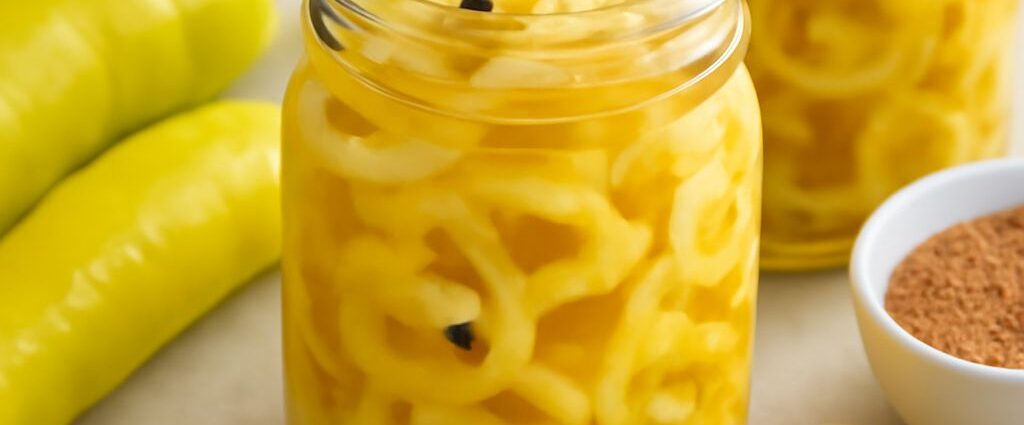
Canning banana peppers safely calls for an acidified pickle, not peppers covered in plain water. This recipe uses 5 cups of 5% acidity vinegar, 1 cup of water, pint jars, 1/2-inch headspace, and a 10-minute boiling-water process.
The vinegar-forward brine preserves even banana-pepper rings while limiting heat exposure for better texture. Use firm, fresh peppers and keep the slices, brine, jars, and processing steps consistent.
Canning Banana Peppers: Peppers, Brine, Jars, and Equipment
4 pounds of peppers, 5 cups of 5% vinegar, and 1 cup of water
- 4 pounds banana peppers: Choose firm, unblemished peppers.
- 5 cups vinegar: Use vinegar labeled 5% acidity. White vinegar keeps the brine pale; apple cider vinegar adds color and flavor.
- 1 cup water: This creates the 5:1 vinegar-to-water brine ratio.
- 2 tablespoons pickling or canning salt: Add for seasoning.
The recipe makes approximately 9 pints, depending on the peppers’ size, slice thickness, and packing density. You will also need hot pint jars, new lids, screw bands, a jar lifter, a bubble remover or plastic utensil, a canning funnel, and a boiling-water canner with a rack.
About 9-pint yield with hot pint jars, lids, bands, and a boiling-water canner
Wash the jars, lids, and bands. Inspect jars for cracks or rim chips. Keep the jars hot until filling so hot brine does not shock the glass. Prepare the lids according to the package directions rather than boiling them unless the manufacturer specifically instructs you to do so.
Acidified pickles are not plain peppers processed in water
Do not substitute plain water for the vinegar or reduce the vinegar in this recipe. Pickled peppers are acidified by the vinegar and can be processed in a boiling-water canner. Plain peppers packed in water are a different, low-acid food and are not equivalent; use a tested pressure-canning method for plain peppers instead.
Banana Pepper Canning Recipe: Prepare the Peppers and Brine
Wash, seed, and cut even 1/4-inch rings
- Wash the peppers under cool running water and drain them well.
- Trim off the stems. Slice each pepper into even 1/4-inch rings.
- Remove the seeds and inner ribs if you prefer a milder pickle. Leave some seeds for more heat, if desired.
Uniform slices heat at a similar rate and pack more neatly. Do not use soft, wrinkled, or damaged peppers. Sweet banana peppers work especially well in this recipe, but the same method also suits hotter banana-pepper varieties.
Heat the 5:1 vinegar-forward brine without cooking the peppers
Combine the vinegar, water, and pickling salt in a stainless-steel or enamel saucepan. Bring the mixture to a gentle simmer, stirring until the salt dissolves. Keep the brine hot over low heat, but do not boil it for an extended time. Prolonged boiling can reduce the vinegar and soften the finished peppers.
Keep the sliced peppers raw until the jars are packed. This shorter heat exposure is central to canning crisp banana peppers.
Canning Crisp Banana Peppers: Pack Jars and Process
Pack hot pint jars and leave 1/2-inch headspace
- Set a hot pint jar on a towel or in the canning rack. Pack the pepper rings upright or horizontally, without crushing them.
- Ladle hot brine over the peppers, ensuring the rings are fully covered.
- Leave exactly 1/2 inch of headspace between the brine surface and the jar rim.
- Slide a bubble remover or plastic utensil around the inside edge of the jar. Add a little brine if the level drops below the required headspace.
- Wipe the rim with a clean, damp cloth. Center a prepared lid on the jar, then apply the band fingertip-tight.
Repeat with the remaining jars. Avoid packing the rings too tightly; compressed peppers may not heat evenly and can make it difficult for brine to circulate. Keep the peppers beneath the brine rather than allowing slices to protrude above the liquid.
Remove bubbles, wipe rims, apply lids, and process for 10 minutes after the water returns to a boil
- Place the filled jars upright on the canner rack.
- Lower the rack into the canner. Add enough boiling water to cover the jar tops by at least 1 inch.
- Cover the canner and bring the water to a full, rolling boil.
- Start the timer when the water returns to a boil. Process the pint jars for 10 minutes at elevations up to 1,000 feet. At higher elevations, use the applicable altitude adjustment for pickled foods.
- If the boil stops during processing, return the water to a full boil and restart the timing according to standard boiling-water canning practice.
Keep the jars upright throughout processing. Do not tighten the bands during or immediately after processing, because trapped air must escape as the jars cool.
Canning Sweet Banana Peppers: Cool, Check Seals, and Preserve Texture
Cool jars upright for 12–24 hours before inspecting seals
When the processing time ends, turn off the heat and remove the canner lid, opening it away from your face. Let the jars stand in the canner for 5 minutes. This brief rest helps prevent thermal shock and liquid loss.
Lift the jars straight up with a jar lifter. Set them upright on a towel, leaving space between each jar. Do not tilt, wipe, retighten, or press the lids. Let the jars cool undisturbed for 12–24 hours.
Look for firm rings, clear brine, and properly concave lids while limiting heat exposure
After cooling, remove each band and inspect the seal. A properly sealed lid should be slightly concave and should not flex when pressed in the center. Check that the jar is not leaking and that the peppers remain covered by brine. The liquid should look clear to lightly tinted, without signs of active bubbling or fermentation.
Refrigerate any jar that did not seal and use it promptly. Do not store an unsealed jar at room temperature. Wash and dry the outside of sealed jars, label them with the date, and store them without the bands in a cool, dark, dry place.
For the firmest texture, use peppers soon after harvest, slice them evenly, skip blanching, and avoid simmering the rings in the brine. Follow the 10-minute process exactly rather than extending the time unnecessarily. Longer heating can produce soft peppers, while underprocessing or reducing the vinegar can compromise the acidified pickle.






Comments are closed, but trackbacks and pingbacks are open.