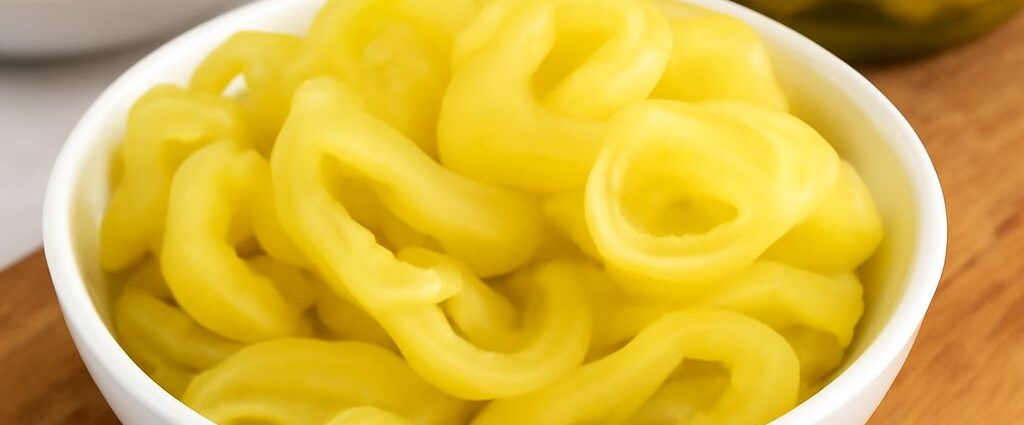
This pickled banana peppers recipe makes about 1 quart of crisp, tangy rings from 1½ pounds of fresh banana peppers. A 1:1 vinegar-to-water brine adds bright acidity without overwhelming the peppers.
Slice the peppers about ¼ inch thick, pour over a hot—not boiling—brine, and refrigerate for 24 hours. The finished rings should stay firm and give a slight snap when bitten.
Pickled banana peppers recipe: Peppers, brine, and a 1-quart jar
Yield: About 1 quart, or 4 cups of pickled pepper rings
Resting time: 24 hours for the best flavor
Storage: Refrigerate and use within 3 to 4 weeks for the best quality
- 1½ pounds fresh banana peppers
- 1 cup distilled white vinegar with 5% acidity
- 1 cup water
- 1 tablespoon pickling salt or fine noniodized salt
- 1 clean 1-quart glass jar with a tight-fitting lid
Choose firm, unblemished peppers. Yellow banana peppers make mild, tangy pickles, while mature orange or red peppers taste slightly sweeter. For a hotter batch, include some of the seeds and inner membranes.
Wash the jar and lid with hot, soapy water, then rinse well. Let the jar come to room temperature before adding hot brine. This refrigerator method does not produce a shelf-stable canned product.
Slice and pack the peppers for a crisp bite
- Rinse the peppers and pat them dry.
- Cut off the stems. Remove the seeds and membranes if you want a milder result.
- Slice the peppers crosswise into rings about ¼ inch thick.
- Pack the rings into the 1-quart jar, pressing them down gently without crushing them.
Slice thickness controls the final texture. Rings thinner than ¼ inch absorb the brine quickly but soften more easily. Much thicker pieces stay firm, although the centers take longer to season.
Leave roughly ½ inch of space at the top of the jar. The peppers will settle slightly after the brine is added. If the jar cannot hold all the slices without forcing them down, reserve the excess rather than compressing the rings tightly.
For the crispest pickles, keep the peppers raw until the brine reaches the jar. Do not simmer or blanch the rings. Heat softens their cell walls and removes the fresh crunch this method is designed to preserve.
Make and pour the hot vinegar brine
- Combine the vinegar, water, and salt in a small saucepan.
- Warm over medium heat, stirring until the salt dissolves.
- Heat the liquid until it is steaming, about 180 to 190°F, but do not bring it to a hard boil.
- Pour the hot brine slowly over the packed pepper rings.
Pour around the inside edge of the jar so the liquid reaches the bottom without trapping large air pockets. Press the peppers down with a clean spoon, then add enough brine to cover every ring.
Submersion matters. Exposed pepper pieces can dry out and discolor, while covered rings season evenly. If a few slices float, place a small clean glass weight on top or gently press them below the surface before sealing.
Wipe the jar rim, close the lid, and let the jar stand at room temperature until it is no longer steaming. Refrigerate it promptly afterward. Avoid pouring boiling liquid into a cold jar, since sudden temperature changes can crack the glass.
Chill and use this pickled banana pepper recipe
Refrigerate the jar for at least 24 hours before serving. The peppers are technically edible after several hours, but a full day gives the vinegar and salt time to season the centers of the rings.
After chilling, the rings should look bright and feel firm. A good ring bends slightly, then gives a light snap when bitten. If the peppers are limp, the slices were likely too thin, the brine was too hot, or the rings were cooked before packing.
Keep the peppers covered with brine and use a clean fork each time you remove some. This helps preserve their texture and keeps crumbs or food particles out of the jar.
- Add them to deli sandwiches, burgers, and grilled sausages.
- Spoon them over nachos, tacos, pizza, or loaded baked potatoes.
- Chop them into tuna salad, egg salad, potato salad, or relish.
- Serve them beside rich foods, where their acidity cuts through cheese and cured meats.
- Stir a little drained brine into a vinaigrette or marinade.
For a less sharp flavor, let the rings chill for 48 hours before serving. The vinegar bite will round out as the peppers absorb more of the brine. Keep the jar refrigerated throughout storage, and discard the batch if it develops mold, an unusual odor, or a slimy texture.
Preserving banana peppers: Refrigerator pickles vs. canned pickles
These are refrigerator pickles, not shelf-stable canned pickles. The hot brine seasons the peppers, but pouring it into a jar and tightening the lid does not make the jar safe for pantry storage.
A shelf-stable product requires more than a sealed lid. Canning involves three essential controls:
- A tested acid ratio: The vinegar strength and vinegar-to-water ratio must come from a tested canning recipe. Do not alter the balance by adding extra water or using lower-acidity vinegar.
- Correct jar preparation and headspace: The peppers and brine go into prepared canning jars with the headspace specified by the tested instructions.
- Boiling-water processing: Filled, closed jars are submerged in a boiling-water canner for the required time, adjusted for elevation when necessary.
That heat-processing step helps destroy spoilage organisms and creates the vacuum seal associated with a properly canned product. A lid that pops down after hot brine is added is not enough by itself.
Do not process this refrigerator pickled banana pepper recipe as written and then store it in the pantry. For preserving banana peppers at room temperature, use a tested canning recipe with its exact vinegar, salt, headspace, and processing directions. Use this version when you want crisp rings that are ready after a day in the refrigerator.









Comments are closed, but trackbacks and pingbacks are open.