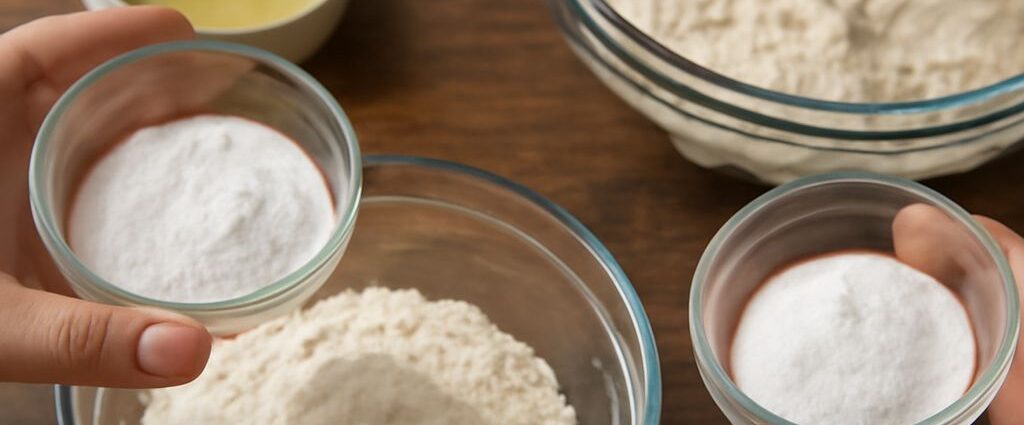
Whether you’re in the middle of a recipe and just realized you’re out of baking powder or are looking for alternatives due to dietary preferences, finding the right baking powder substitute can transform your baking experience. This guide will explore various options, explain the baking powder to baking soda ratio, and offer tips for successful baking swaps.
Understanding Baking Powder
Baking powder is a leavening agent used to help baked goods rise. It is a combination of an acid (usually cream of tartar) and a base (baking soda), along with a moisture-absorbing agent. When mixed with liquids, it produces carbon dioxide gas, which causes the dough to expand. Understanding its role is crucial when looking to substitute it effectively.
Top Baking Powder Substitutes
Though baking powder is common, there are several alternatives you can use:
- Baking Soda and Cream of Tartar: Mix 1/4 teaspoon baking soda with 1/2 teaspoon cream of tartar to replace 1 teaspoon of baking powder.
- Baking Soda and Buttermilk: Use 1/4 teaspoon baking soda with 1/2 cup buttermilk for each teaspoon of baking powder. Reduce other liquid ingredients accordingly.
- Yogurt and Baking Soda: Similar to buttermilk, 1/4 teaspoon baking soda with 1/2 cup yogurt works well. Adjust the liquid content as needed.
- Lemon Juice and Baking Soda: Combine 1/4 teaspoon baking soda with 1/2 teaspoon lemon juice for each teaspoon of baking powder.
- Vinegar and Baking Soda: Mix 1/4 teaspoon baking soda with 1 tablespoon vinegar to replace 1 teaspoon of baking powder.
Using Baking Soda as a Substitute
Baking soda can be an effective substitute when combined with an acid. However, the baking powder to baking soda ratio is crucial. Typically, 1 teaspoon of baking powder is equivalent to 1/4 teaspoon of baking soda plus an acid. Ensuring the right balance is key to achieving the desired rise and texture.
Dairy-Free Swaps in Baking
For those who need dairy-free alternatives, here are some options:
- Almond Milk and Baking Soda: Use 1/4 teaspoon baking soda with 1 tablespoon of lemon juice mixed into almond milk to mimic buttermilk.
- Coconut Milk and Vinegar: Combine 1/4 teaspoon baking soda with coconut milk and add 1 tablespoon apple cider vinegar for acidity.
- Oat Milk and Lemon Juice: Similar to almond milk, add lemon juice to oat milk with baking soda.
These substitutions maintain the fluffy texture without needing dairy, catering to various dietary restrictions.
Tips for Successful Baking
Using a baking powder substitute can be tricky, but with these tips, you can ensure success:
- Measure Accurately: Precise measurements are crucial in baking, especially when substituting ingredients.
- Mix Thoroughly: Ensure all ingredients are well incorporated to avoid uneven rising.
- Adjust Liquids: When adding acidic components like yogurt or buttermilk, reduce other liquids to maintain the right batter consistency.
- Experiment Carefully: Each substitute may affect the taste and texture differently, so you might need to experiment with small batches.
- Know Your Recipe: Understanding the role of each ingredient in your recipe can help you make better substitution choices.
Armed with these strategies, you can seamlessly replace baking powder and still enjoy delicious, well-textured baked goods. Remember, experimentation and practice will lead to the best results!








Comments are closed, but trackbacks and pingbacks are open.